
Pregnancy as a Developmental Opportunity
Exploring Adult Development, Maternal Agency, and Long-Term Stability
A Working Framework from 3 Times As Many, Inc.
1. What have we noticed?
Chronic adversity can require people to continually prioritize immediate needs leaving less cognitive and emotional bandwidth for imagining a different future, pursuing long-term goals, and navigating complex systems. Yet pregnancy is already understood as a period of significant biological, psychological, relational, and identity transition.
2. What are we asking?
Could pregnancy represent an underutilized developmental opportunity—one in which psychologically safe, strengths based, developmentally timed support can strengthen the capacities in women that help shape their lives and families’ future?
3. What do we propose?
The Adult Development During Pregnancy Framework proposes that pregnancy itself does not produce developmental change. Rather, for some women, the identity reconsideration, heightened emotional significance, changing role expectations, and increased attention to the future associated with pregnancy may create conditions of developmental readiness. With appropriate support, this period may offer an opportunity to strengthen Maternal Developmental Capacity (MDC) – an integrated capability expressed through reflection, self-efficacy, future orientation, purpose, Agency, Structured Goal Pursuit and Executive Functioning.
Strengthened MDC may help individuals recognize opportunities as personally relevant, translate aspirations into sustained action and more effectively utilize available healthcare, education, workforce, and community resources.
4. How are we testing it?
3 Times As Many is operationalizing the framework through the Maternal Empowerment Program, a four-session, cohort-based intervention that moves participants through a developmental sequence of reflection and identity future vision and purpose structured planning persistence and adaptive response to obstacles. Participants identify strengths, imagine possible futures, establish a meaningful 12-month goal, translate that goal into monthly objectives and weekly actions, anticipate barriers, and receive peer support and structured follow-up.
5. Why might this matter?
If the framework is supported by evidence, its implications extend beyond maternal health. Maternal-Health systems could consider adult development alongside risk reduction and service delivery. Workforceprograms could explore developmental readiness and opportunity recognition as precursors to conventional job readiness. Philanthropy could invest not only in expending access to opportunity, but also in understanding and strengthening the capacities that help people recognize, pursue, and sustain the opportunities they choose.
Access without developmental capacity may leave opportunities difficult to use. Capacity-building without material access may leave aspirations impossible to act upon. Sustainable mobility requires both.
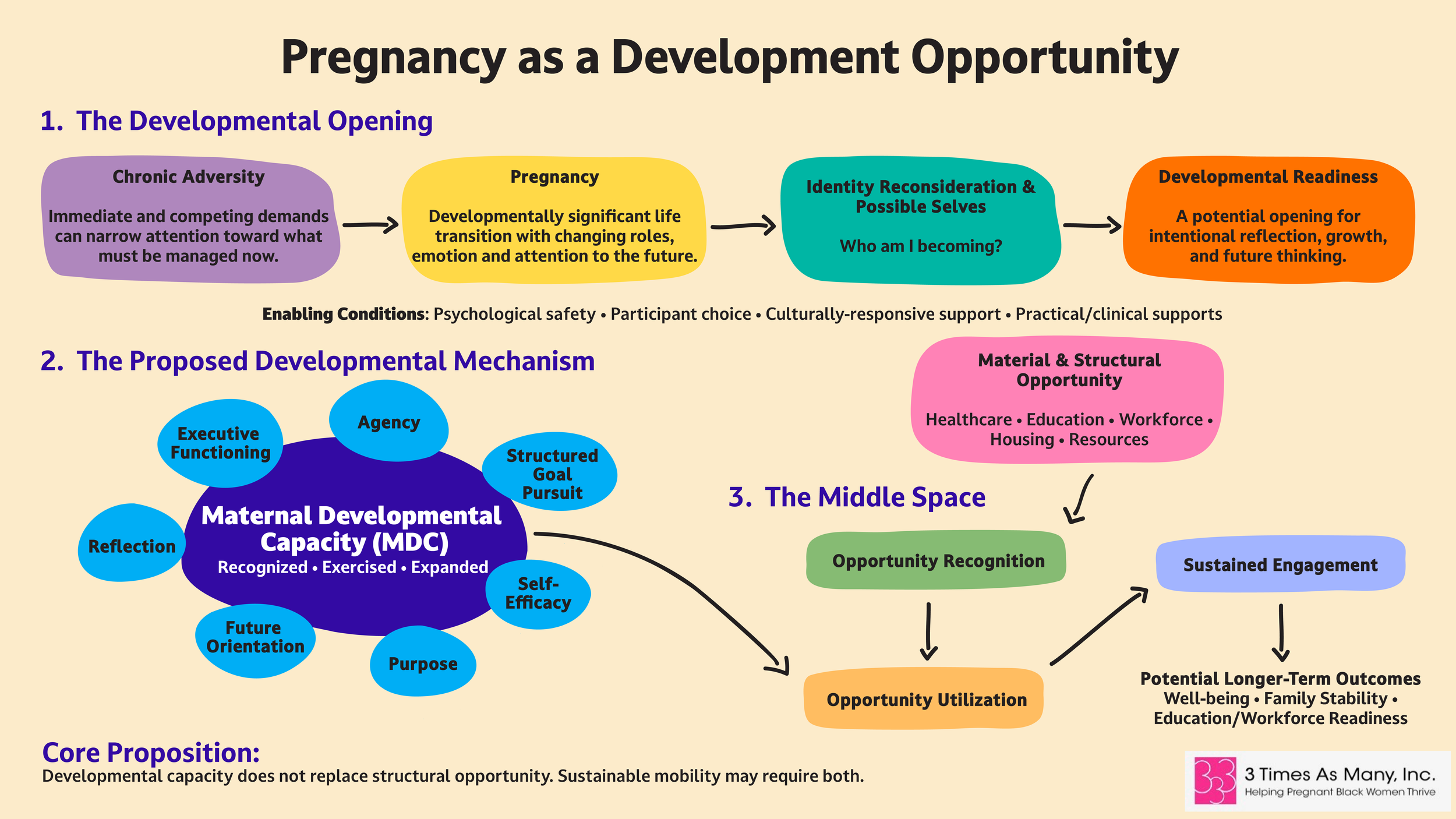
Pregnancy is proposed as a potential developmental opening—not a cause of change. Under enabling conditions, MDC may be recognized, exercised and expanded. MDC then meets real material and structural opportunity in the “middle space” between access and outcomes.